How to Choose Pads Diapers for Bulk Buying?
Bulk buying Pads Diapers requires more than comparing carton prices. It requires evidence, planning, and a clear understanding of daily use. Household needs can change quickly. A newborn may need eight to twelve diaper changes daily, while an adult user may require different absorbency levels overnight.
Industry data shows why this category deserves careful evaluation. Fortune Business Insights valued the global adult diapers market at about USD 17.46 billion in 2023. Its report projects continued growth through 2030, driven by aging populations, healthcare demand, and improved product awareness. Grand View Research also identifies disposable diapers as a major global consumer market, supported by rising hygiene expectations and convenience-focused purchasing. These figures show strong demand, but they do not guarantee that every bulk deal offers real value.
Check absorbency, sizing, skin-contact materials, packaging, and supplier consistency. A low unit price can become expensive when leakage causes waste. Measure actual weekly consumption before ordering several cartons. A simple record beside the changing table can reveal useful patterns. Count unopened packs, not assumptions. The WHO and UNICEF Joint Monitoring Programme continues to report serious gaps in household hygiene access worldwide, reminding buyers that product availability and affordability remain important concerns. Sustainability also deserves attention, although disposable products still create waste. This is where bulk buying becomes less simple. The best choice balances comfort, protection, storage space, delivery reliability, and total cost per use. Supplier claims should be checked against technical sheets, certifications, customer feedback, and sample testing. One carton may look economical. It may not suit real life.
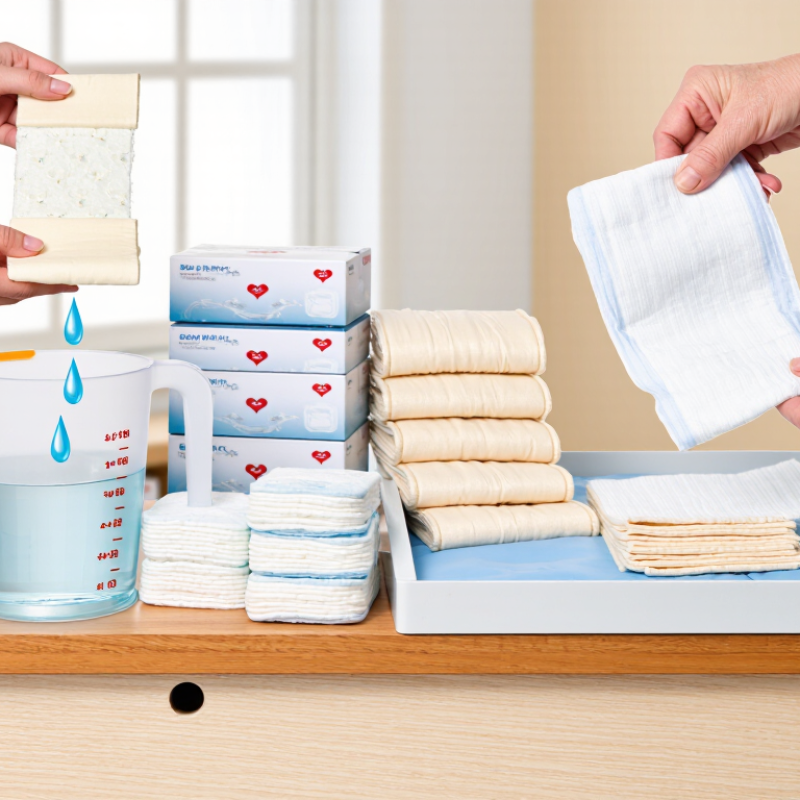
Classify Baby Diapers and Pads by Use, Fit, and Product Specifications
Bulk buying works best when baby diapers and pads are classified by use, fit, and specifications.
Newborn diapers suit frequent changes and softer waistlines. Crawling babies need flexible side panels and secure tabs.
Overnight diapers require stronger absorbent cores and wider back coverage. Training pants support independent dressing. Changing pads protect furniture during messy moments.
Fit should follow the child’s weight, waist shape, and movement, not age alone. Check leakage around the legs, red pressure marks, and gaps near the back. For pads, compare length, width, adhesive strength, and intended flow level.
Product specifications also matter. Review absorbency claims, core materials, dimensions, pack count, fragrance information, and sealed packaging. Fortune Business Insights reported that the global baby diaper market reached about USD 83.09 billion in 2023, showing the scale of this purchasing category. Yet market size does not guarantee suitability.
Tips: Buy one small trial pack before ordering cartons. Record leakage, skin comfort, and change frequency for seven days. A simple spreadsheet helps, but it can still mislead when babies grow quickly. Leave room for one size change. The wrong bulk order becomes expensive storage. Use professional guidance from EDANA’s absorbent hygiene resources and compare technical sheets carefully. Parents should also inspect every pack for damaged seals, uneven materials, or unclear specifications before storage.
Convert Daily Consumption into 30–90-Day Demand and 10–20% Safety Stock
How to Choose Pads Diapers for Bulk Buying?
Bulk buying should begin with real usage, not carton size or promotional pricing. Record daily consumption for at least two weeks. Separate daytime pads, overnight pads, and diapers by size. A household using eight pads and four diapers daily needs 360 units for 30 days. For 90 days, the same demand reaches 1,080 units. Check package quantities before ordering. A “case” may contain different inner packs.
Add a 10–20% safety stock after calculating the base demand. For 360 units, this means 36–72 extra units.
A 30-day supply would therefore range from 396 to 432 units.
Use 10% when deliveries are dependable and storage space is limited. Use 20% when demand changes, children grow quickly, or local delivery often takes longer. Keep products dry, sealed, and away from direct sunlight. Moisture can damage absorbency and packaging.
Tips:
Track actual use on a simple calendar. Note leaks, skin discomfort, size changes, and unused packs. These details matter more than assumptions. My early estimates were too neat. A sudden illness, travel, or a child’s growth changed the numbers quickly. Review the stock every two weeks, and adjust the next 30–90-day order. Do not buy excessive quantities only because the unit price looks lower. A perfect forecast is impossible. A documented, flexible estimate is safer.
Compare Absorbency Using ISO 11948-1 Capacity and Rewet Test Results
Choosing pads or diapers for bulk buying requires more than reading the stated capacity. Ask for ISO 11948-1 test results and check the exact product size tested. This gravimetric method measures how much liquid the item retains under controlled laboratory conditions. Capacity is useful, but it does not fully represent overnight or active-use performance.
Review rewet results with equal care. Rewet testing measures how much liquid returns toward the surface after pressure is applied. Lower rewet usually suggests a drier skin-contact layer. Look for test details, including liquid volume, loading time, pressure, and sample conditioning. Without these details, two impressive numbers may not be comparable. Small differences matter when a wearer sits for hours. A damp surface can also signal poor fluid distribution, even when total capacity looks strong.
For bulk purchasing, compare several samples from the same production lot when possible. Check leakage, odor control, fit, and fastening strength during normal movement. Capacity can change with size, core design, and fluid type. ISO testing uses controlled conditions, not every real-life situation. That limitation deserves attention. A product with the highest capacity may feel bulky or perform poorly around the edges. I would record both capacity and rewet in a simple table, then test comfort over a full day before ordering cartons. Test results guide the decision. They do not replace practical observation.
How to Choose Pads Diapers for Bulk Buying? – Compare Absorbency Using ISO 11948-1 Capacity and Rewet Test Results
Anonymous comparison of adult absorbent pad and diaper samples using capacity, rewet, leakage-control, and bulk-purchasing indicators.
| Sample Code | Product Format | Nominal Size | ISO 11948-1 Capacity
(g / approx. mL) | Capacity Result
(Mean ± SD) | Rewet After Pressure
(g / approx. mL) | Rewet Result
(Mean ± SD) | Wet-Back Rating | Leakage-Control
Features | Bulk-Buying
Guidance |
| AD-01 | Day-use pull-on diaper | Medium | 1,180 | 1,180 ± 42 | 1.8 | 1.8 ± 0.4 | Very low | Elastic leg cuffs; standing leakage guards | Recommended |
| AD-02 | Day-use pull-on diaper | Large | 1,420 | 1,420 ± 55 | 2.4 | 2.4 ± 0.5 | Low | High-rise waist; dual leg barriers | Recommended |
| AD-03 | Overnight tab-style diaper | Large | 1,760 | 1,760 ± 61 | 2.1 | 2.1 ± 0.3 | Low | Wide core; reinforced backsheet; refastenable tabs | Recommended |
| AD-04 | Overnight tab-style diaper | Extra Large | 2,080 | 2,080 ± 73 | 2.9 | 2.9 ± 0.6 | Low | Extended rear core; high side barriers | Recommended |
| AP-01 | Shaped insert pad | Regular | 620 | 620 ± 27 | 1.5 | 1.5 ± 0.3 | Very low | Adhesive strip; contoured side edges | Recommended for light use |
| AP-02 | Shaped insert pad | Extra Long | 890 | 890 ± 35 | 2.2 | 2.2 ± 0.4 | Low | Longer core; standing leakage guards | Recommended for moderate use |
| AP-03 | Shaped insert pad | Maxi | 1,070 | 1,070 ± 46 | 4.6 | 4.6 ± 0.8 | Medium | Adhesive strip; moderate side barriers | Trial before bulk order |
| AP-04 | Shaped insert pad | Maxi Plus | 1,260 | 1,260 ± 51 | 6.8 | 6.8 ± 1.1 | Medium-high | High-capacity core; limited side containment | Avoid without wear trial |
Test and purchasing notes: Capacity values are reported as grams of test liquid retained, with 1 g treated as approximately 1 mL for comparison purposes. Each anonymous sample represents the mean of five tested units; SD means standard deviation. ISO 11948-1 is used here as the stated total-absorption capacity method. Rewet values were obtained after liquid loading followed by a defined pressure application and are presented as comparative wet-back results; lower values indicate a drier surface. Results can vary with size, fit, body position, loading rate, test liquid, and laboratory procedure. Confirm the exact test protocol, sample size, packaging integrity, and user fit before placing a large-volume order.